You Switched to Castile Soap—But Is It Actually Better for Your Skin?
For many people, Castile soap is one of the first swaps they make when moving toward a more natural lifestyle. It makes sense. Traditional Castile soap has a beautifully simple foundation, is made through the traditional saponification of vegetable oils rather than relying on conventional detergent-based cleansing systems, and has become almost synonymous with the idea of "natural soap."
It was one of our first swaps, too.
When we began creating botanical cleansers and body washes at The Mindful Gem, Castile seemed like the obvious choice: recognizable, plant-based and already trusted by natural-minded consumers. But as we continued formulating with it, we kept noticing the same thing. It cleaned beautifully—almost too beautifully. Our Castile-based formulations could leave skin with that tight, squeaky feeling we've been conditioned to associate with cleanliness.
As we learned more about skin physiology and botanical formulation, we began questioning whether that sensation was really something we wanted from an everyday cleanser. Instead of accepting dryness and tightness as the tradeoff for choosing a more natural soap, we started looking deeper into how soap actually interacts with the skin—and whether the plant world offered another way.
That's when reetha changed the way we thought about cleansing.
The Part About Castile Soap We Don't Talk About Enough
One of the most important lessons we've learned as botanical formulators is that "natural" isn't necessarily synonymous with "gentle." Castile soap is a perfect example. Traditional Castile is what chemists call a true soap. Vegetable oils are combined with an alkali through a process called saponification, transforming those oils into fatty-acid salts: soap.
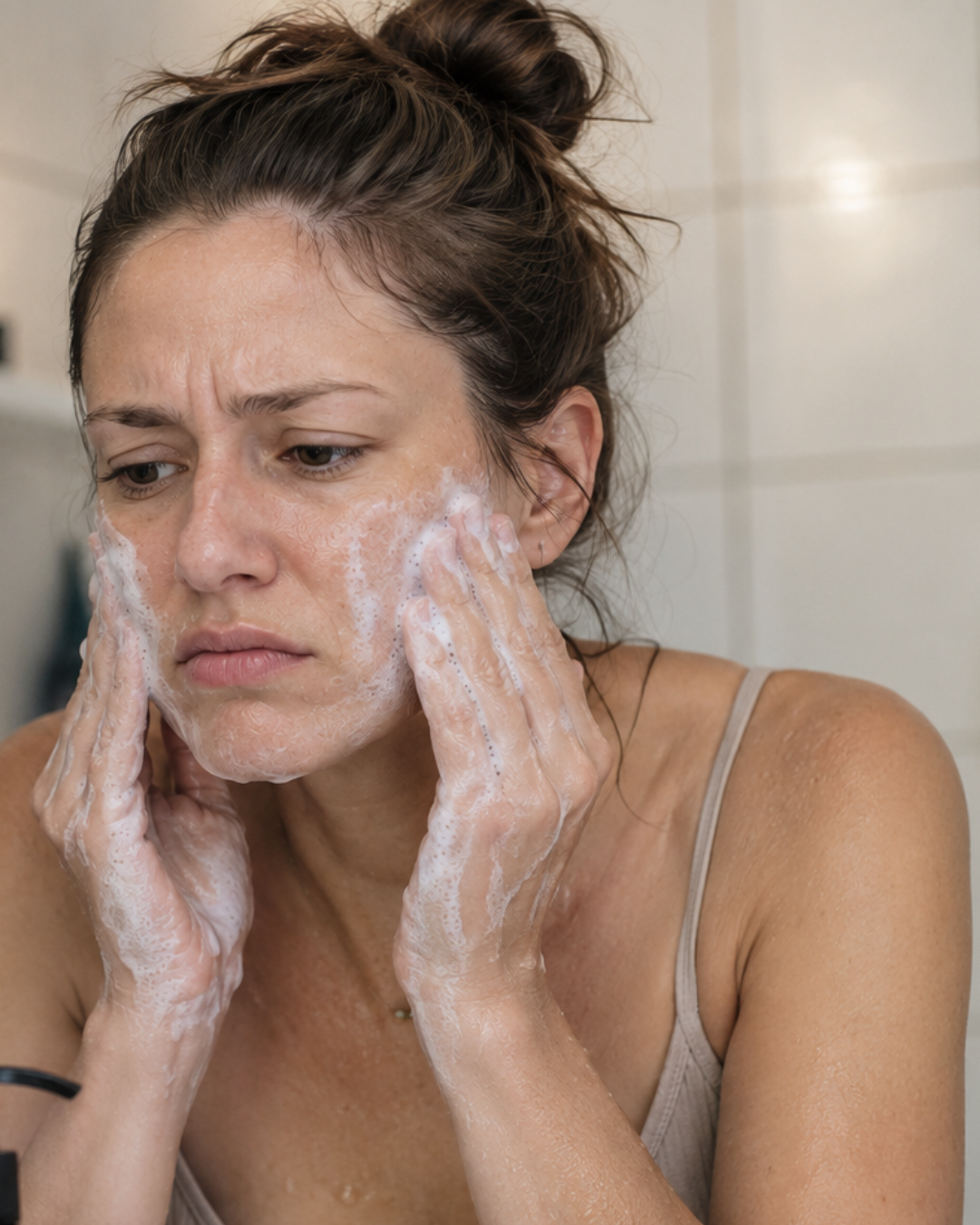
That chemistry matters when the product is being used on skin. Healthy adult skin naturally maintains a mildly acidic surface. Published research reports normal skin surface values broadly within the acidic range, with measurements commonly around pH 4.5–5.5 depending on the person, body site and testing conditions. One large study estimated the natural skin surface pH at an average of approximately 4.7. True soap is very different. Published evaluations commonly place traditional soap around pH 9–10, with broader reviews reporting approximately pH 8.5–11. That's a substantial difference.
That mildly acidic surface helps support normal barrier function and creates conditions that favor the skin’s natural microbial ecosystem. Research has repeatedly shown that washing with alkaline soap can temporarily raise skin surface pH. True soap is also very good at its primary job: removing oils and debris. That's one of the reasons it has remained useful for centuries. But when we're formulating specifically for everyday skin cleansing, maximum degreasing isn't necessarily our goal…
Your skin isn’t a countertop.
That mildly acidic surface helps support normal barrier function and creates conditions that favor the skin’s natural microbial ecosystem. Research has repeatedly shown that washing with alkaline soap can temporarily raise skin surface pH. True soap is also very good at its primary job: removing oils and debris. That's one of the reasons it has remained useful for centuries. But when we're formulating specifically for everyday skin cleansing, maximum degreasing isn't necessarily our goal…
Your skin isn't a countertop.
The outermost layer of your skin contains lipids that help it hold onto moisture and maintain its protective barrier. Dermatological literature notes that strong true-soap cleansing can remove skin sebum and beneficial intercellular lipids, with repeated alkaline cleansing associated with dryness and disruption of normal barrier processes. That "squeaky clean" sensation we've learned to associate with cleanliness therefore isn't necessarily evidence that skin is healthier. Sometimes it simply means we've removed more than we needed to. For us, that was reason enough to start looking for another botanical cleansing system.
The Cleanser That Grows on Trees
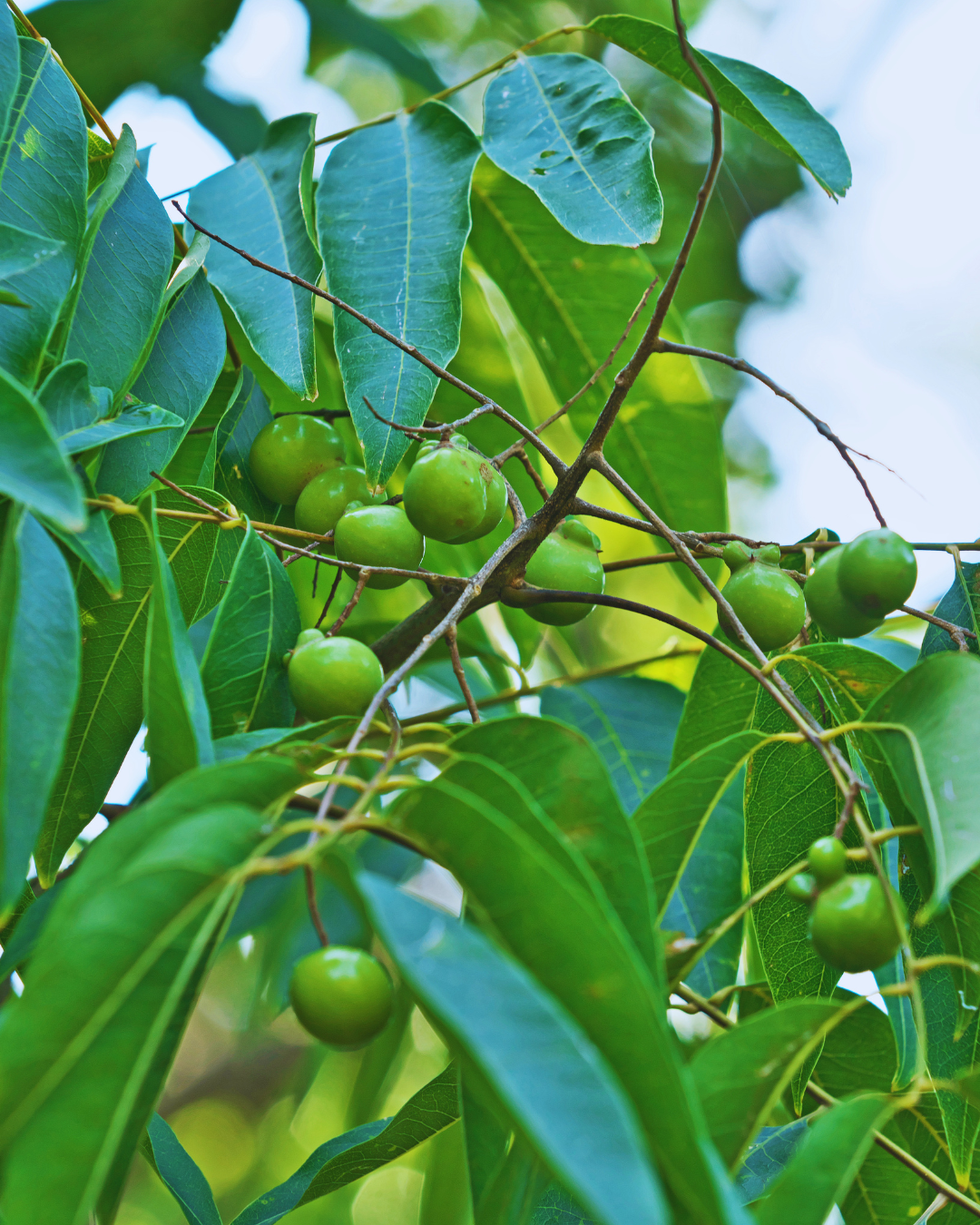
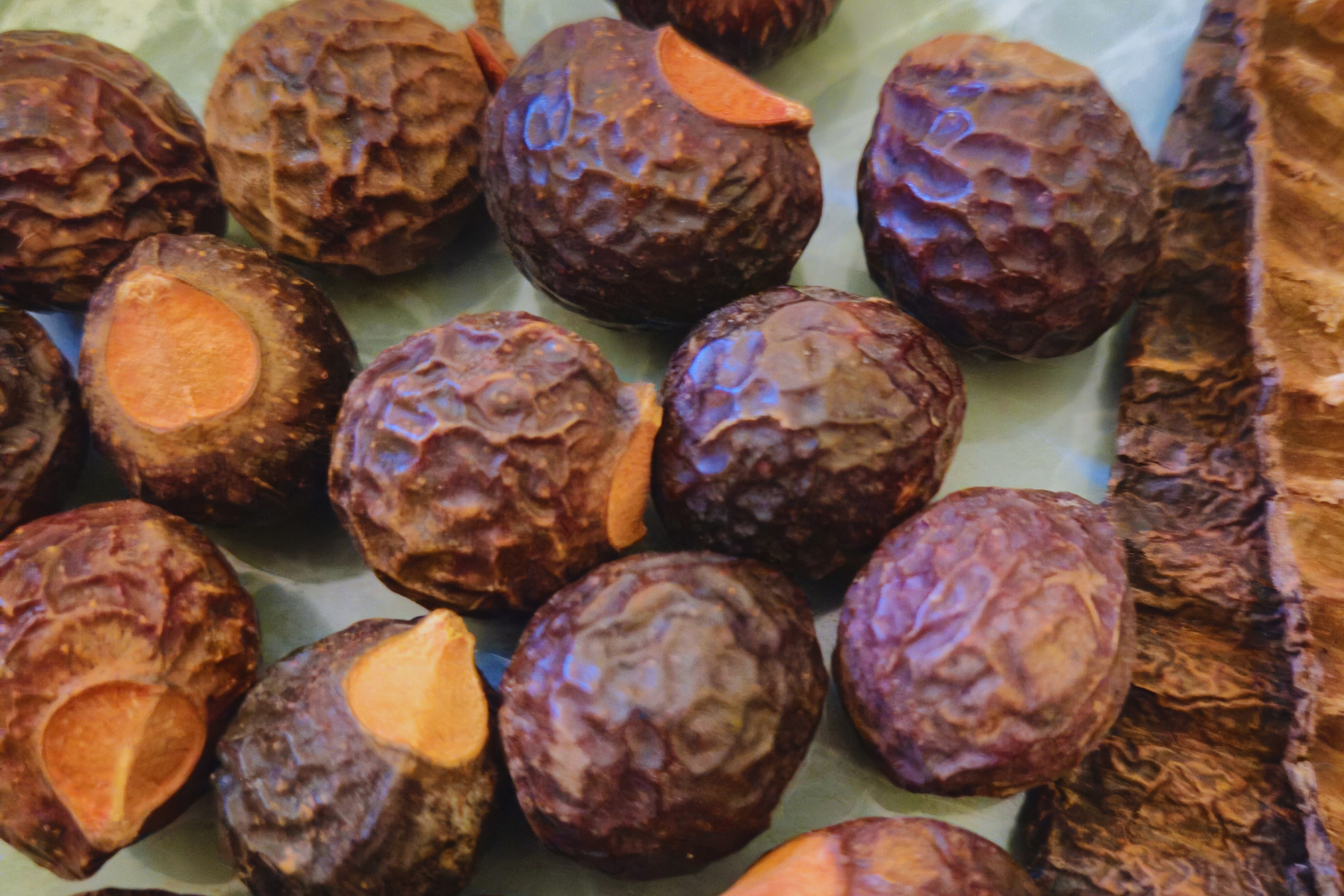
Our search eventually brought us to reetha (Sapindus species), commonly known as soapnut or soapberry. Reetha has a long history of traditional cleansing use, particularly throughout South Asia, and its fruit contains something remarkably useful: naturally occurring compounds called saponins.
Saponins have surfactant properties! Their molecular structure allows them to interact with both water and oily substances, giving them useful washing, foaming, emulsifying and surface-active characteristics. Scientific reviews of Sapindus mukorossi specifically identify its triterpenoid saponins as natural surfactants and document measurable detergent and foaming properties.
In other words, reetha doesn't have to be transformed into traditional soap in order to cleanse. The fruit itself contains compounds capable of doing the cleansing. That distinction became incredibly important to us. Because we're not relying on traditional saponified soap as the cleansing foundation, we have greater freedom to think about the formula as a whole: How strongly should it cleanse? How should skin feel afterward? What botanical extracts, humectants and conditioning ingredients make sense alongside it?
Rather than beginning with Castile and asking, "What can we add to this soap?" we can begin with the skin and ask, "What do we want this entire cleanser to accomplish?"
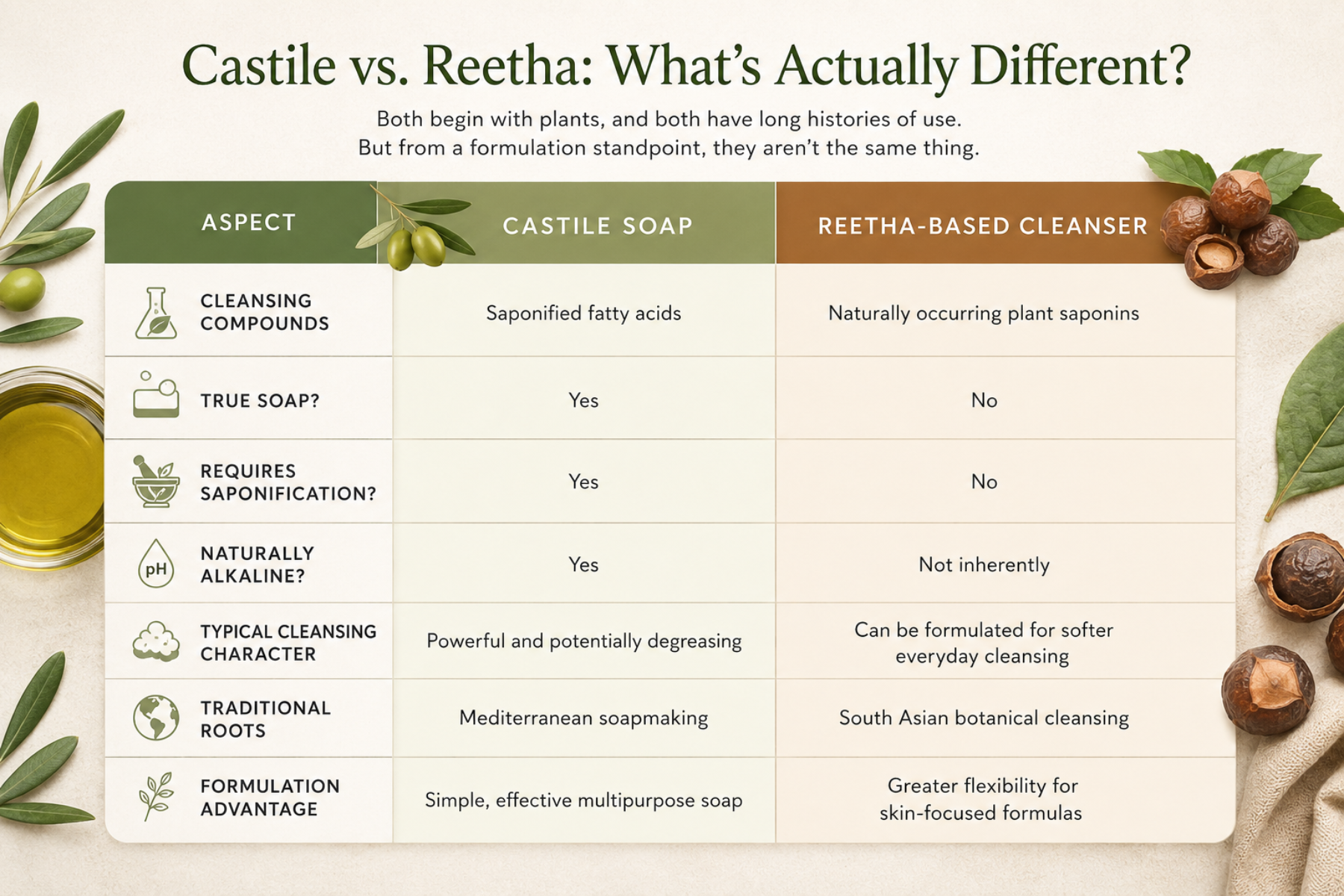
Castile vs. Reetha: What's Actually Different?
Both begin with plants, and both have long histories of use. But from a formulation standpoint, they are fundamentally different cleansing systems. That distinction is ultimately what changed our formulations. It's important to say that reetha isn't automatically gentle simply because it grows on a tree. Saponins are biologically active cleansing compounds, and concentration matters. So do extraction method, preservation, final pH and every other ingredient surrounding them. And that's precisely why formulation matters.
We don't simply soak soapnuts in water and call it skincare. We use reetha as part of a thoughtfully constructed botanical cleansing system. For us, that offers something traditional Castile doesn't: the freedom to create a botanical cleanser without building the entire formula around inherently alkaline true-soap chemistry. For everyday skin cleansing, we think that's a meaningful advantage.
What About the Lather?
One of the first things people may notice when transitioning away from traditional soap is that the lather can feel different. We've spent decades associating mountains of bubbles with superior cleaning power (read more in our article From Folk Soap to Foam Empire), but foam itself isn't a direct measurement of how effectively a cleanser removes unwanted oils and debris.
Interestingly, research into Sapindus mukorossi has demonstrated that its saponin-rich extracts possess genuine foaming and surface-active properties. So reetha can absolutely lather; it simply gives formulators another botanical route to achieving cleansing and foam. In our products, we're less interested in chasing maximum bubbles than finding the balance between effective cleansing, satisfying lather, botanical ingredients and comfortable skin after rinsing.
Once you stop expecting your skin to squeak afterward, you may begin noticing something much more important: it feels clean without that stripped, tight sensation that led us away from Castile in the first place.
So, Is Reetha Actually Better Than Castile?
Not for every possible application. Castile soap is remarkably versatile, and its cleansing power is precisely what makes it useful for so many purposes. But when we're talking specifically about something you're using on your skin every day, our preference is clear.
For the body washes, hand washes and skin cleansers we create at The Mindful Gem, we prefer a thoughtfully formulated reetha-based cleansing system over traditional Castile soap. Not because Castile is "toxic." It isn't. And not because everything natural is automatically superior—it isn't. We've simply moved beyond asking "Is it natural?" We want to know whether an ingredient makes sense for its purpose, how it behaves in a finished formulation, how its chemistry interacts with the skin, and ultimately how the finished product leaves your skin feeling.
That's why our formulas evolved.
Why We Left Castile Behind
Our transition from Castile to reetha wasn't created as a marketing story. We actually formulated with Castile first. We used it, learned from it and eventually decided it wasn't giving us the cleansing experience we wanted our products to provide. As our understanding of botanical formulation grew, our definition of natural skincare grew with it.
Today, our approach is to remove what doesn't belong—sweat, grime, excess oil and everyday buildup—while being mindful of what does: the lipids, moisture and delicate surface environment that help skin function as skin. For us, reetha provides a remarkable botanical foundation for doing exactly that. Its traditional history fascinates us, its naturally occurring saponins make it genuinely functional, and its formulation possibilities allow us to create the kind of cleansers we wish we'd discovered when we first started making natural swaps ourselves.
So if Castile soap was one of your first natural swaps too, we're not here to tell you that you made the wrong choice.
It may simply not have to be your last one.
Try a thoughtfully formulated reetha-based cleanser and pay attention to your skin after you rinse—not just to whether it feels clean, but whether it still feels comfortable. Because we've come to believe that "natural" isn't the finish line. It's where we start. Sometimes innovation means creating something entirely new. And sometimes it means looking back at what people have been using for generations and realizing that nature already gave us another way.
Ready to Move Beyond Castile?
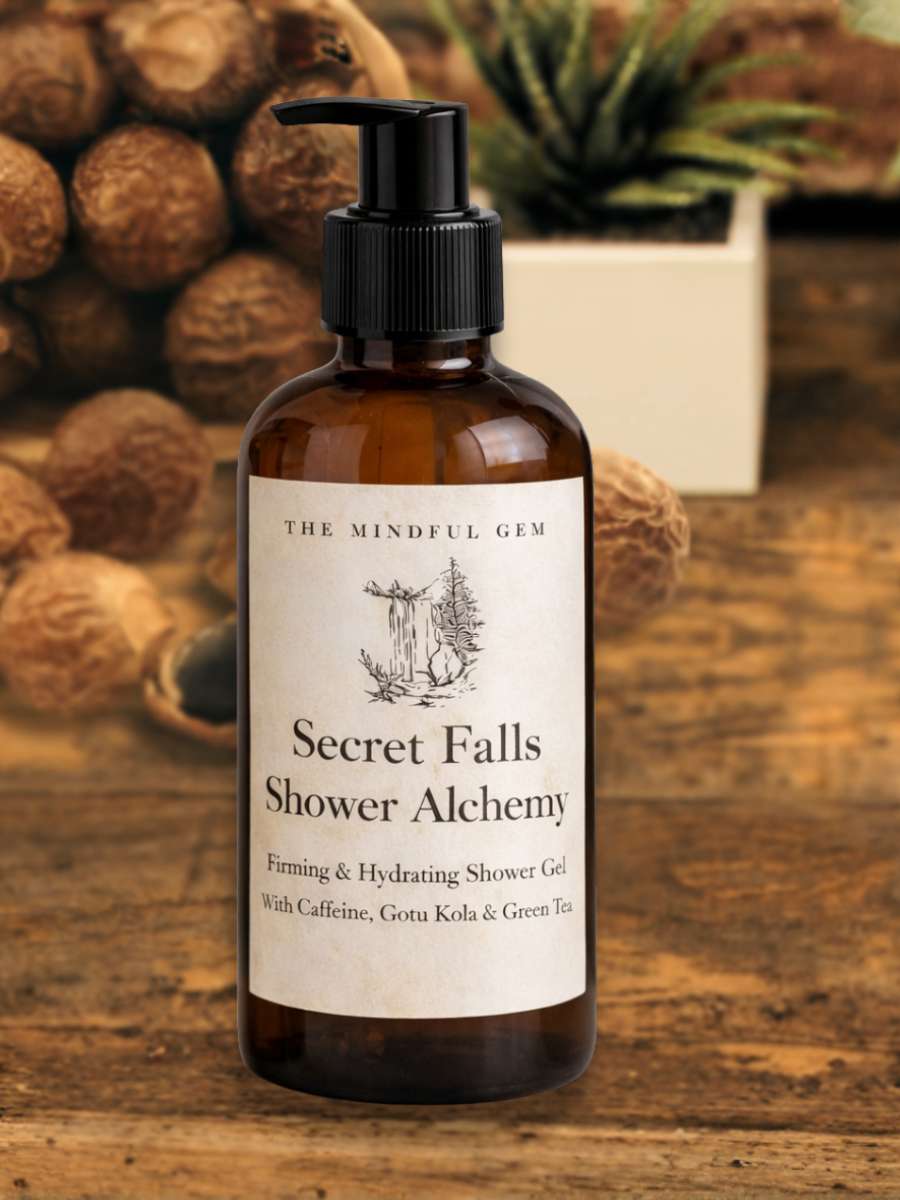
Explore The Mindful Gem's reetha-based botanical cleansers, thoughtfully formulated to cleanse effectively without the stripped, squeaky-clean feeling that led us away from traditional Castile soap in the first place.
What the Research Says
Our decision to move away from Castile soap for everyday skin cleansing began with our own experience, but the chemistry behind that experience is well established. Here's a closer look at some of the research that informs our formulation philosophy.
Healthy Skin Is Naturally Acidic
“The ‘natural’ skin surface pH is on average 4.7, i.e. below 5.”
In a multicenter study of 330 people, researchers examined skin surface pH before and after participants refrained from showering and applying cosmetic products for 24 hours. They estimated the natural average skin surface pH to be approximately 4.7. The study also found better measures of barrier function, moisturization and scaling when skin pH was below 5 compared with above 5.
This is one reason pH matters when we think about something we're going to put on our skin every day.
— Lambers H, Piessens S, Bloem A, Pronk H, Finkel P. International Journal of Cosmetic Science, 2006.
True Soap Is Much More Alkaline
“The typical pH of a true soap is 9 to 10.”
Castile soap falls into the category of true soap: fatty acids transformed through saponification with an alkali. That chemistry naturally produces an alkaline cleanser, in contrast with the naturally acidic surface of our skin.
This doesn't mean Castile is “toxic” or that using it once will damage healthy skin. It does help explain why we ultimately decided that traditional true-soap chemistry wasn't the foundation we wanted for our everyday botanical skin cleansers.
— Journal of Clinical and Aesthetic Dermatology, review of over-the-counter cleansers and moisturizers.
Powerful Cleansing Can Have a Tradeoff
“Soaps are strong OTC cleansers that do an excellent job of removing skin sebum and debris.”
That sounds like a compliment—and in some applications, it absolutely is. But the same dermatological review explains that soaps can also remove beneficial intercellular lipids and affect proteins within the stratum corneum, the skin's outermost protective layer.
In other words, getting skin as oil-free as possible isn't necessarily the same thing as caring for it well. This helped change the way we thought about that familiar squeaky-clean feeling: we wanted our cleansers to remove what needed to go without making maximum degreasing the goal.
— Journal of Clinical and Aesthetic Dermatology, review of over-the-counter cleansers and moisturizers.
Reetha Really Does Contain Natural Cleansing Compounds
“Soapnut saponins show adequate detergent properties to consider them as a potential substitute for synthetic surfactants.”
Reetha (Sapindus mukorossi) contains naturally occurring saponins with measurable surface-active properties. A scientific review of the plant describes washing, foaming, emulsifying, solubilizing and surface-active characteristics associated with these compounds.
That doesn't mean every homemade soapnut preparation is automatically gentle or that reetha has been clinically proven superior to Castile in every circumstance. Concentration, extraction, pH and the finished formulation all matter.
What it does mean is that reetha provides a genuinely functional botanical cleansing system—one that allows us to formulate without relying on inherently alkaline true soap. For The Mindful Gem, that's exactly what we were looking for.
— Triterpenoid Saponins from Washnut (Sapindus mukorossi Gaertn.)—A Source of Natural Surfactants and Other Active Components, Plants, 2022.
Sources
Lambers H, Piessens S, Bloem A, Pronk H, Finkel P. “Natural skin surface pH is on average below 5, which is beneficial for its resident flora.” International Journal of Cosmetic Science. 2006;28(5):359–370. DOI: 10.1111/j.1467-2494.2006.00344.x.
Draelos ZD. “A Guide to the Ingredients and Potential Benefits of Over-the-Counter Cleansers and Moisturizers for Rosacea Patients.” Journal of Clinical and Aesthetic Dermatology. 2011;4(8):31–49.
Triterpenoid Saponins from Washnut (Sapindus mukorossi Gaertn.)—A Source of Natural Surfactants and Other Active Components. Plants. 2022;11(18):2355.
Research is provided for educational context and to explain our formulation philosophy. Individual skin responses vary, and the properties of an individual ingredient do not by themselves determine the performance of a finished formulation.
