Relational Compliance: Why Forcing Alignment Breaks Intimacy

Have you ever felt like you are ‘dragging’ your partner along, or like they’re doing that to you?
Human beings are not static creatures—we are highly dynamic. Different situations bring out different aspects of ourselves. New perspectives reshape our values, habits, and priorities. We are built to evolve over time, though the pace and direction of that evolution varies widely from person to person.
When you enter a romantic relationship, your timing and energy link up. Circumstances and attractions differ, of course, but from a basic relational standpoint, your frequencies align enough to create intimacy. The depth of intimacy a couple can hold is closely tied to this compatibility. This is why honeymoon phases exist—the felt experience of unusually high coherence. The challenge is that life does not remain static, and neither do we.
Outside forces exist. Inner forces do too. Change is inevitable.
What Is Relational Compliance?
Energetic dragging, or more formally “relational compliance”, emerges when growth creates divergence and the relationship attempts to maintain closeness without true alignment. It can show up in two complementary roles. One partner begins to shift—values, lifestyle, health, emotional awareness, or capacity for presence—and attempts to bring the other along. The other partner may resist openly or more subtly, agreeing outwardly while remaining unchanged inwardly. In both cases, movement happens without shared readiness.
In plain terms, something in one person changes, and the relationship enters a moment of choice. Invitations to change are often attempts to preserve or deepen intimacy, not acts of control or judgment. Yet when change is initiated externally rather than arising internally, it often creates strain. The initiating partner may feel frustrated or alone. The reluctant partner may feel pressured, inadequate, or overwhelmed. Intimacy begins to thin.
Have you ever started a new venture to improve your health, immediate environment, or sense of purpose, only to be met with resistance from your partner? Or perhaps they expressed interest verbally, but showed little follow-through? This dynamic doesn’t only affect the person initiating change. In fact, it often impacts the reluctant partner more deeply, creating internal conflict between the desire to stay connected and the inability or unwillingness to shift.
When we try to initiate change in another person from the outside, it frequently creates dissonance rather than movement. Over time, this dissonance can reinforce existing patterns—sometimes even unhealthy ones. The growing difference in frequency erodes intimacy. Physical closeness may remain, but it often masks a lack of coherence. Attempts to force reconnection only deepen the internal split for both people.
When I refer to dissonance here, I am speaking about sustained nervous system stress—the kind that accumulates quietly and can contribute to emotional numbness, depression, maladaptive coping behaviors, or a general sense of depletion. This is not about blame. It is about the cost of prolonged misalignment.
This dynamic can surface even in healthy or seemingly “good” relationships. No one is immune. It can arise from something as simple as a change in appearance. Hair is an easy, everyday example. A partner alters their style. The other reacts. That response either meets the change with curiosity and flexibility, or introduces subtle withdrawal. Attraction shifts are not failures; they are information. What matters is whether the response brings you closer or quietly adds weight to the wall between you.
Diet is another common example, and often a more charged one. I once witnessed this firsthand within my own family. After my mother decided to become vegetarian, her partner reacted with anger and withdrawal, eventually refusing to cook for her as he had before. Over time the intensity softened, but a degree of disconnect remained. Years later, he independently sought out a cleaner diet for health reasons and was deeply grateful for the knowledge she had gained earlier. The timing simply had not been aligned.
These patterns appear everywhere—health and fitness, finances, spirituality, emotional awareness, and social priorities. We are all in flux. Change rarely comes from ill intent. Most of us are trying to move toward greater well-being or coherence in some way. When we invite a partner into that movement, it is often an attempt to connect, not to shame or threaten abandonment.
Receptivity to change is shaped not only by temperament but also by personal history. Trauma, shame, and unprocessed experiences strongly influence what feels possible or safe. In this sense, growth invitations are also mirrors. They reveal where a relationship has the capacity to expand together and where it does not. Honest acknowledgment of this mismatch is often the first real opportunity for intimacy, not its end. This is also what makes relationships (and life!) interesting: things continue to unfold and evolve over time- as long as you choose to deepen intimacy.
Growth-Oriented Relationships vs. Stagnant Ones
When this dynamic surfaces, relationships tend to move in one of two directions. Some couples remain together while slowly accommodating less intimacy—coping, avoiding, or settling into parallel lives. Others begin to dissolve. The partner feeling pressured may leave due to shame, exhaustion, or resentment. The partner seeking growth may eventually disengage in order to preserve their own vitality.
As a tantric consultant, this is often the stage at which people seek support—when they begin to question the long-term viability of the relationship. What I frequently observe is one partner leaning toward expansion and deeper intimacy while the other placates, resists, or withdraws. This is particularly painful because it confronts a deeply ingrained cultural ideal: that love alone should be enough to carry a relationship through all phases of life.
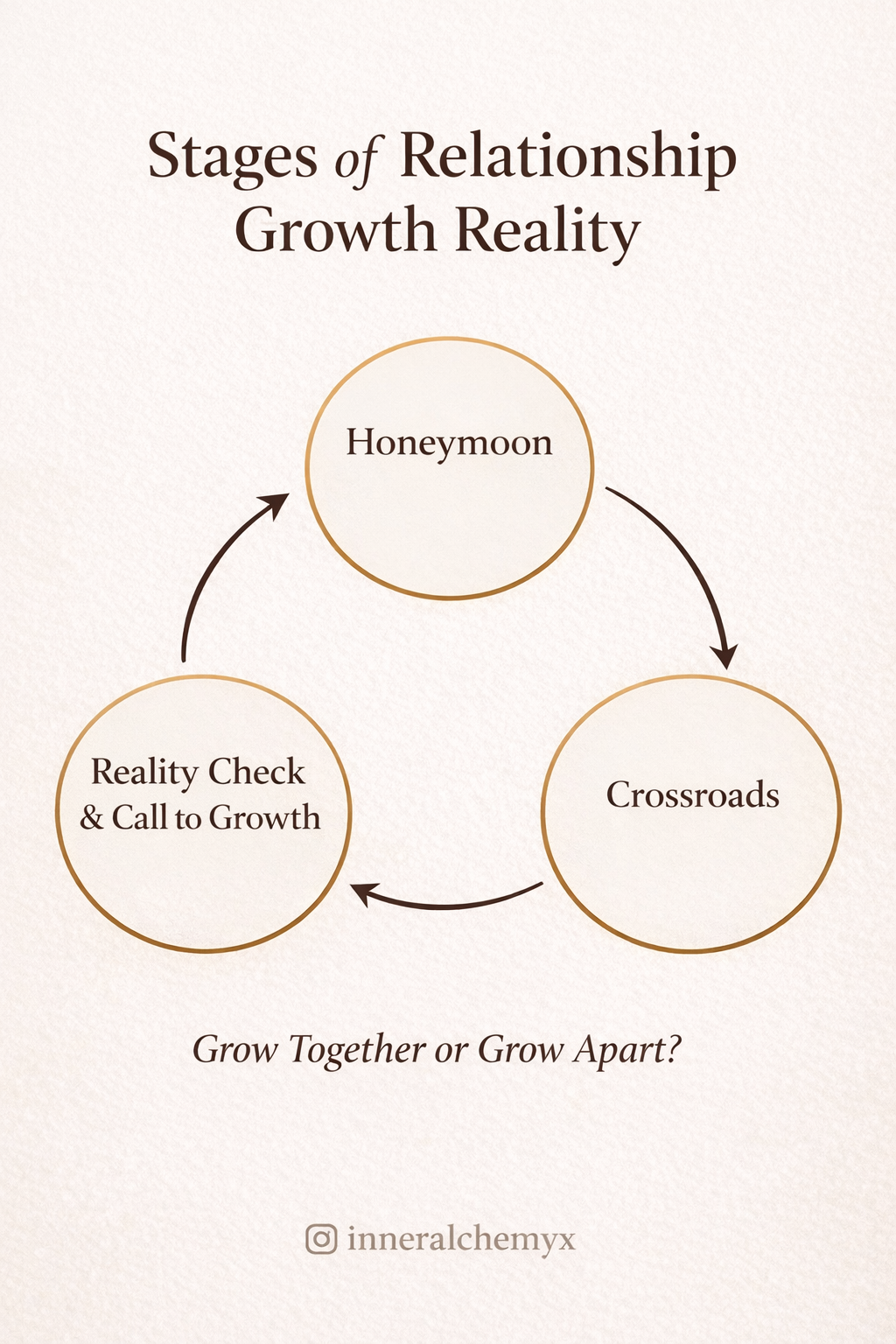
What is often missing is radical honesty. This is the true transition point from honeymoon to maturity. Honeymoon leads to reality, reality invites growth, and from there intimacy either deepens through truth or dissipates through avoidance.
When Intimacy Turns Unsafe
This territory is not superficial by any means. We fight for intimacy, and intimacy is tied to our personal sovereignty. Our earliest relational templates—often shaped in childhood—profoundly affect how we respond to closeness, feedback, and change. For some, these wounds are mild. For others, they are severe and raw.
In certain cases, advocating for positive change or expressing dissatisfaction can provoke volatility or violence. This is a hard boundary. Any form of physical or emotional violence requires immediate intervention or departure. No relationship, regardless of history or potential, justifies sacrificing safety or sovereignty. Change only becomes sustainable when it arises from within. It cannot be coerced, rescued, or endured into existence.
This is especially important for highly empathetic or sensitive individuals, who may unconsciously frame another’s healing as their responsibility. This path leads to self-erasure. We are each responsible for the health of our inner world and the boundaries of our intimate bonds.
Relational Consent and Personal Limitations
When we grant someone intimate access—our body, time, values, emotions, and care—we create a shared relational field. Communication is essential for that field to remain alive. When communication is consistently avoided or distorted, the connection begins to serve one person at the expense of the other.
Consent in relationships is not only verbal. It is expressed through tone, presence, follow-through, and emotional availability. If someone is unwilling or unable to articulate their truth, that limitation cannot be forced away. It can only be acknowledged. The question then becomes whether that limitation is something you can live with.
Some differences are minor. Others are structural. Some require healing support. Discernment—not endurance—is what protects intimacy over time.
If you want to understand your own limitations regarding intimacy, reflect on your last strong relational trigger. Did you pause to get curious about its origin, or did you move immediately into defense or avoidance? Relationships are potent teachers, but only when both people are willing to self-reflect. This capacity cannot be negotiated into existence.

The Middle Ground: Where Do We Go From Here?
If you find yourself in relational limbo—unsure whether intimacy can be restored or whether your paths are diverging—this is not automatically a sign that the relationship is ending. It’s an invitation to evaluate the honesty and safety of communication. Can you express your needs without fear? Are you asking for something the other person cannot or does not wish to offer? Do your long-term visions still intersect?
Avoiding these questions does not prevent their consequences. Remaining in misaligned relationships for convenience or fear carries a cumulative cost. Over time, truth deferred becomes truth expressed through the body.
Presence Equals Progress
When we are fully present with another, we can sense excitement, hesitation, or resistance without forcing clarity. Most people, given time, show us who they are. Intimacy deepens not through acceleration, but through accurate perception and creating a safe emotional container.
If this dynamic is alive in your relationship, it does not mean failure is imminent. It means it is time to pause, evaluate, and speak honestly. Life together is a long game. Strategy, communication, and mutual growth are not optional. Intimacy cannot be dragged into existence. It emerges when truth is allowed to lead.
If this dynamic feels familiar in your relationship, you don’t have to navigate it alone. I offer private tantric consultations for individuals and couples who want clarity, embodied honesty, and grounded tools for relational growth. You can learn more or book a session through Inner Alchemy X.
